Key Takeaways
Dubai’s Short-Term Rental Market Is Booming: With high occupancy rates, strong RevPAR, and government-backed initiatives like the Golden Visa, Dubai offers one of the most lucrative markets for vacation rental growth.
Automation Is Crucial to Scale Efficiently: Manual management can’t keep up with compliance and guest expectations. Tools like Avantio’s PMS help automate guest messaging, listing sync, financial reporting, and task workflows.
Strict Regulations Require Proactive Compliance: Operating legally means securing a DET license, registering guests with Dubai Police, displaying permit numbers, and meeting safety requirements—especially for property managers with 8+ units.
The Right Tech Unlocks Regional and Global Visibility: To succeed in Dubai and expand to Abu Dhabi or Sharjah, property managers need a tech stack that supports local OTAs like Bayut and Dubizzle, alongside global platforms like Airbnb and Booking.com.
Dubai’s short term rental market is booming.
Driven by strong tourism and investor-friendly regulations, the UAE is becoming a hotspot for digital hospitality.
Property managers have a unique opportunity to scale efficiently with short term rentals Dubai, especially with the right tools and local knowledge.
What Are Short Term Rentals Dubai?
Short term rentals Dubai are furnished residential properties rented for less than six months.
Regulated by the Department of Economy and Tourism, these “holiday homes” must be rented out as entire units. You cannot rent partial or shared-room arrangements.
Differences Between Short-Term Rentals and Traditional Long-Term Leases in Dubai
| Feature | Short Term Rentals Dubai | Traditional Long-Term Leases |
| Duration | Typically under 6 months (often 90 days or less) | Usually 1 year or more |
| Furnishing & Utilities | Fully furnished with furniture, appliances, internet, and utilities included | Often unfurnished or semi-furnished; utilities not included |
| Regulatory Compliance | Requires a DET holiday home permit and Dubai Police guest registration | Requires a standard Ejari tenancy contract |
| Guest Profile | Targeted at tourists, business travellers, and digital nomads | Designed for residents or long-term expats |
What Types of Short-Term Rental Properties Exist in Dubai?
There are a variety of short term rentals in Dubai, appealing to a diverse array of guests.
Is the Short Term Rental Market in Dubai Growing?

Dubai’s short term rental market was valued at over US$630 million in 2023, and it’s predicted to grow at a 7.5% CAGR through 2025.
In 2023, Dubai ranked first globally for RevPAR (revenue per available rental). Now, in 2025, Short term rentals Dubai earn an average of AED 158,000 (US$43,000) per year, with occupancy rates around 71% and over 34,500 active Airbnb listings.
A key factor driving this revenue growth is the popularity of Dubai’s Golden Visa program, which attracts long-term visitors and investors.
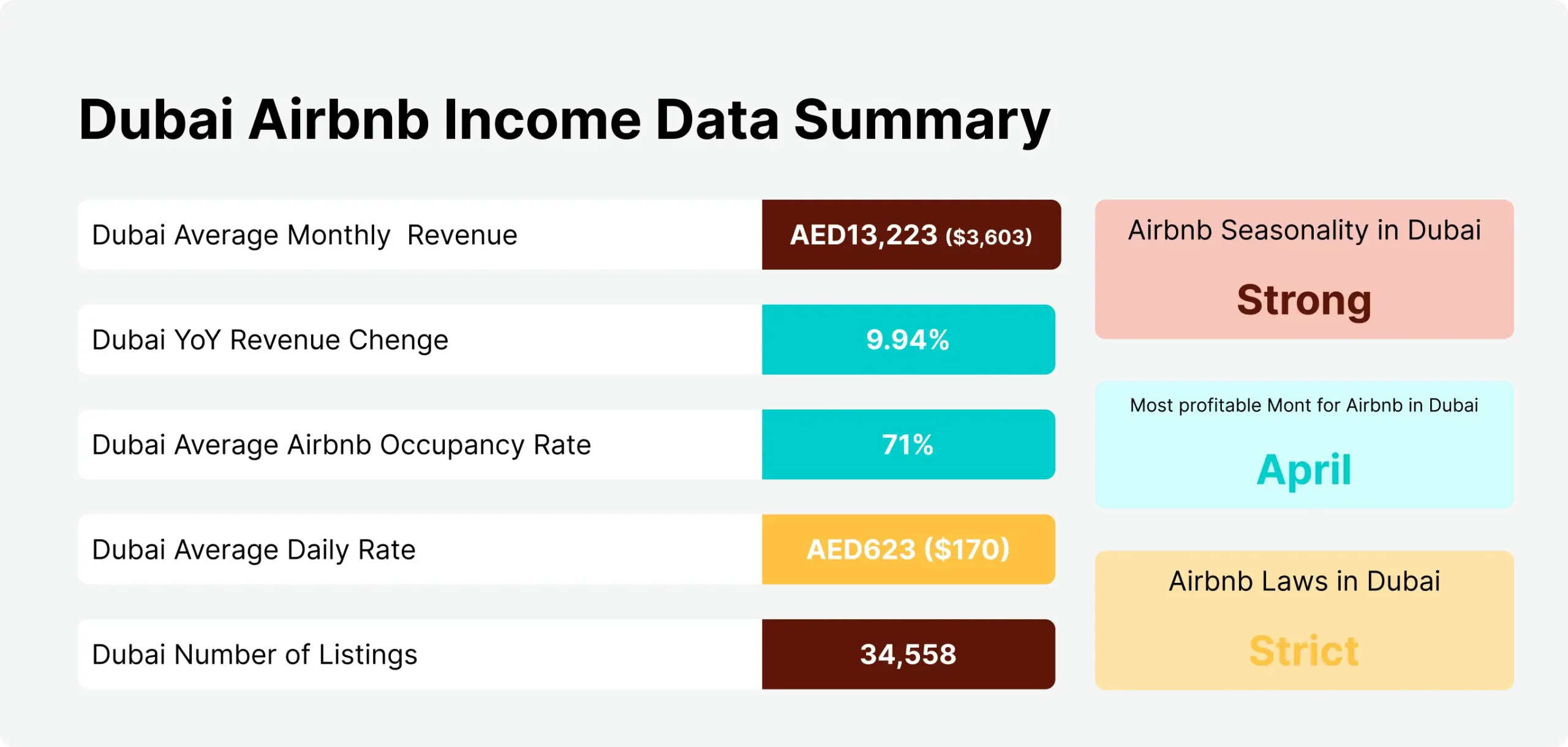
Source: Airbitics
Government Initiatives Growing Short Term Rentals in Dubai
Licensing for Short‑Term Rentals Dubai
Individual homeowners can apply online for a holiday home license through DET, valid for one year with an annual renewal.
Property managers with multiple vacation rentals Dubai must register as a licensed operator, requiring a trade license when managing more than eight units.
Essential Compliance Regulations in Dubai
What Are the Challenges for Property Managers in Dubai’s STR Market?
These challenges show why relying on manual processes can hinder your vacation rentals Dubai business growth.
Uncontrolled Management without Tools
✅Pros:
- Flexibility to list on multiple platforms
- Greater reach across booking channels
❌Cons:
- High risk of double-bookings and pricing inconsistencies across platforms
- Manual guest communications slow response times and reduce guest satisfaction
Regulatory Pressure and Guest Vetting
✅Pros:
- Increased safety and transparency for guests and hosts
- Stronger government support through structured compliance systems
❌Cons:
- Mandatory racking tools require real-time guest check-in/out submissions. Missing entries can lead to fines
- Security compliance involves passport/ID verification and long-term recordkeeping, adding to the admin workload



Simplify Your Dubai Rental Business with Avantio
Say goodbye to complicated workflows and manual tasks.
Avantio’s all-in-one PMS and channel manager help automate guest communication, sync listings across platforms, and generate real-time owner reports for your vacation rentals Dubai.
Schedule a callHow Can Property Managers Succeed in the UAE Short-Term Rental Market?
What Tools Help Automate Short Term Rentals Dubai?
To compete in this growing short term rentals Dubai market, automation is vital. Property managers using Avantio’s vacation rental software can organize operations and scale efficiently.
Unified calendar and pricing sync: Avoid double bookings and rate discrepancies across Airbnb, Booking.com, Vrbo, Blueground, and more.
Auto-generate owner reports: Create and send financial summaries and occupancy reports.
Automated guest messaging: Use customizable templates for check-in instructions, support replies, and review requests, all managed through a single inbox.

How Do You Deliver a Better Guest Experience in Dubai’s STR Market?
Guest satisfaction results in good guest reviews, repeat bookings, and profit.
Responsive communication: Provide helpful and clear communication before, during, and after the guest’s stay with a smart Unified Inbox and automation tools.
Smart access and concierge features: Offer self check-in with keyless smart locks, 24/7 guest access, and on-demand concierge services.
Why Should You Use a Professional Property Management System in the UAE?
A professional PMS like Avantio saves you time with a centralized dashboard to manage multiple units. It auto-syncs with AED and international payment processors, reducing manual work.
Avantio’s task management software is mobile-friendly and includes onboarding tailored to Dubai’s compliance requirements.
What Are the Short Term Rental Opportunities Beyond Dubai?
Short Term Rentals in Abu Dhabi and Sharjah
Abu Dhabi now allows short-term rentals through its Department of Culture and Tourism (DCT). Holiday home licenses are available to both individual owners and companies. The process includes safety checks, registration, and a 6% tourism fee.
Alternatively, Sharjah is gradually opening STRs in designated tourism zones. Licensing is limited and currently available only to companies. With average STR earnings at AED 44,700 (US$12,200) and 53% occupancy, some property managers might see this as an emerging market with room to grow.
Pro Tip: Expanding into Abu Dhabi and Sharjah helps property managers reduce risk, reach new guest profiles, and scale operations beyond Dubai using the same tech stack and tools.
Frequently Asked Questions (FAQs)
Do I need a license for short term rentals in Dubai?
- Yes, through the DET. Individual and corporate licenses are available.
How much money can I make with vacation rentals in Dubai?
- Depends on location and occupancy, but average RevPAR in prime areas exceeds $200/night.
Can foreigners operate vacation home rentals in Dubai?
- Yes, if you own property or partner with a licensed management company.
What software do I need to manage vacation rentals in Dubai?
- A PMS like Avantio helps with automation, compliance, and distribution.